Bus Rental Dubai: How to Plan Group Transportation Without Wasting Time or Budget
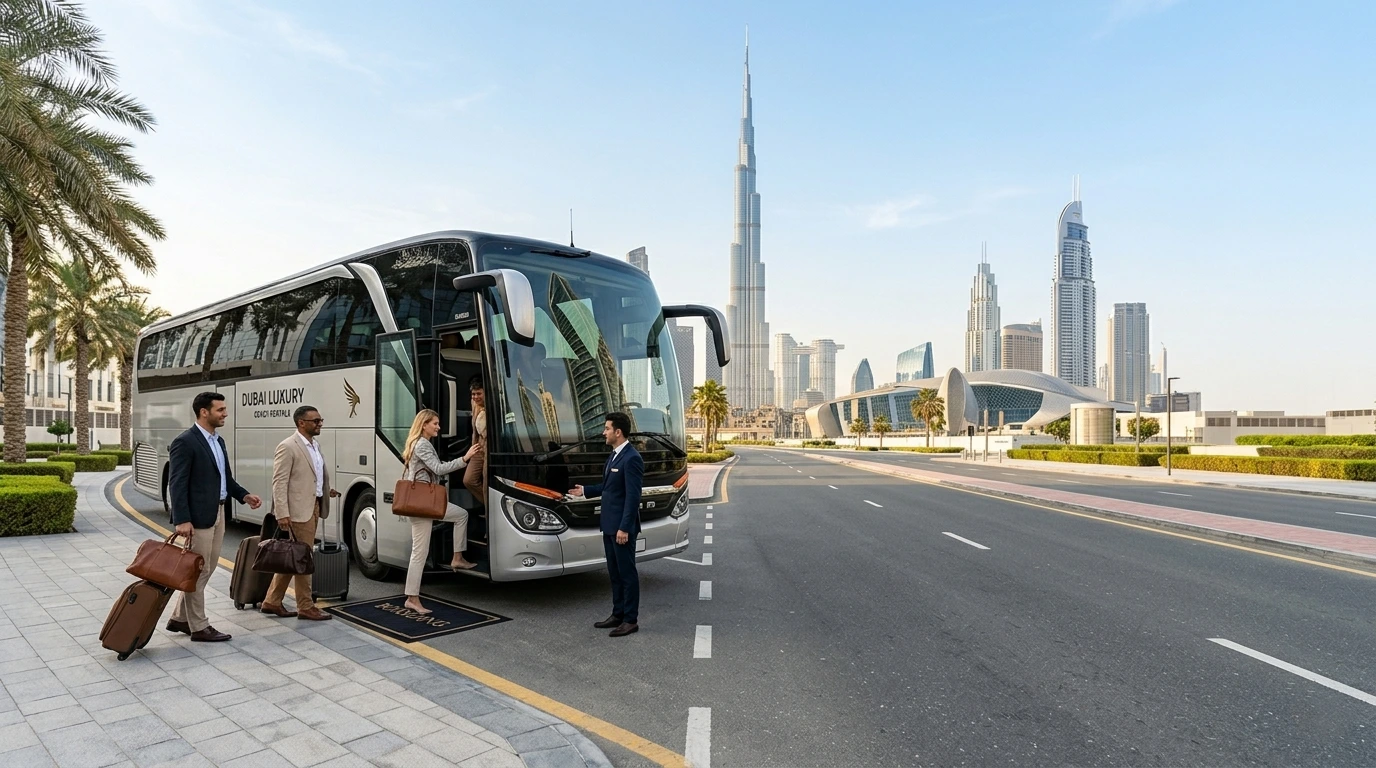
Booking transport in Dubai is easy.
Planning it properly is not.
That difference becomes obvious when a company needs to move 30 employees before 8:00 AM, a family arrives at Dubai International Airport with twelve suitcases, or an event organizer has guests staying across several hotels.
In these situations, transportation is no longer just about finding a vehicle.
It becomes a scheduling problem.
A capacity problem.
A route-planning problem.
And, if handled poorly, a cost problem.
That is why choosing a Bus Rental Dubai service should begin with the journey itself rather than the vehicle.
The most expensive transport arrangement is not always the largest bus.
Sometimes the real expense comes from booking the wrong vehicle, creating an inefficient route, adding unnecessary waiting hours, or dividing a group across too many cars.
This guide explains how to structure group transportation in Dubai more intelligently.
Start With the Movement, Not the Vehicle
A common mistake is beginning the booking process with a question such as:
“How much is a 30-seater bus?”
That sounds reasonable, but it skips the information that actually determines the right transport solution.
A better starting point is:
- How many people are traveling?
- Where are they starting from?
- Where are they going?
- Are there multiple stops?
- How much luggage is involved?
- Is the journey one way, return, or full day?
- Does everybody need to arrive together?
- Is the schedule fixed or flexible?
Once these questions are answered, the vehicle choice becomes much easier.
For example, 18 passengers may require a larger vehicle if they are traveling with airport luggage, but the same 18 passengers attending a business meeting with only laptop bags may comfortably use a smaller option.
This is why professional Bus Rental Dubai planning should be based on the real operating requirement rather than advertised seat capacity alone.
Why “Cheapest Vehicle” Can Become the More Expensive Booking
Transport costs are frequently misunderstood because customers compare only the initial rental amount.
But the cheapest quoted vehicle is not always the cheapest complete solution.
Consider two scenarios.
Scenario A: Several Cars
A group of 15 passengers books four separate cars.
The organizer now has to coordinate:
- Four drivers
- Four pickup confirmations
- Four vehicle locations
- Four possible arrival times
- Four sets of luggage arrangements
- Potentially different routes
If one vehicle is delayed, the whole group may not arrive together.
Scenario B: One Mini Bus Rental
The same group travels together in one vehicle.
There is one pickup schedule, one driver, one route, and one arrival.
The headline price of several cars may initially look competitive, but operationally the minibus can be considerably easier to manage.
For business groups, conferences, airport arrivals, weddings, and tours, this reduction in coordination can be more valuable than a small difference in rental price.
Think in Terms of Passenger Flow
Good transportation planning is about passenger flow.
Passenger flow simply means understanding how people move from one stage of the journey to another.
For example:
Hotel → exhibition → restaurant → hotel
looks simple.
But several operational questions immediately appear:
What time does the exhibition start?
How long does registration take?
Are passengers staying at one hotel or several?
Does the vehicle wait during the exhibition?
Will everyone leave at the same time?
Is the restaurant on the return route?
Will passengers carry exhibition materials back with them?
Answering these questions can completely change the required booking.
A short one-way transfer may become a full-day rental.
A small vehicle may need to become a larger bus.
One pickup point may need to become three scheduled collection points.
The better the passenger flow is understood, the more efficient the final transport plan becomes.
When Mini Bus Rental Is the Better Operational Choice
A mini bus rental is often one of the most efficient categories for Dubai transportation because it sits between two extremes.
It offers more practical group capacity than a standard car while avoiding the unnecessary size of a full coach.
This makes minibuses useful for:
- Small corporate teams
- Family groups
- Airport transfers
- Hotel transfers
- Private tours
- Production teams
- Wedding guests
- Staff movement
- Small event groups
- Business delegations
However, the number of seats should never be the only decision factor.
The Hidden Luggage Problem
Suppose a group contains 14 passengers.
A vehicle with 14 passenger seats may appear suitable.
But if each traveler has one large suitcase and one cabin bag, luggage volume can become a major limitation.
This is particularly relevant for:
- Airport pickups
- Cruise passengers
- Long-stay tourists
- Sports teams
- Production crews
- International delegations
When requesting a mini bus rental, always communicate both passenger and luggage quantities.
A vehicle should be selected according to usable capacity, not theoretical maximum occupancy.
Why Route Design Matters More Than Most People Expect
Dubai traffic is heavily influenced by location, time of day, major events, and road conditions.
A poorly designed pickup route can add unnecessary travel time even when the destinations are relatively close.
Imagine an employee transport vehicle collecting staff from six locations scattered across Dubai.
If those pickups are arranged without geographic logic, the bus could repeatedly cross the same parts of the city.
That increases:
- Journey time
- Fuel usage
- Driver hours
- Passenger waiting
- Risk of late arrival
A better solution is usually to create logical pickup clusters.
For example:
Zone 1
Dubai Marina and JLT
Zone 2
Al Barsha and Barsha Heights
Zone 3
Business Bay and Downtown Dubai
Passengers can be assigned to the nearest central collection point.
This approach is particularly useful for long-term staff transportation and recurring corporate routes.
Corporate Bus Rental Should Be Built Around Reporting Time
Employee transportation is different from tourism transportation.
For tourism, arriving 10 minutes later may only affect part of an itinerary.
For employees, arriving 10 minutes late may affect:
- Shift handover
- Customer service operations
- Manufacturing schedules
- Warehouse operations
- Construction activities
- Office attendance
- Project timelines
That means corporate transport should be planned backwards from the required arrival time.
Suppose employees must report at 8:00 AM.
Planning should begin with:
Required arrival: 7:45 AM
Then account for:
- Final approach traffic
- Pickup delays
- Multiple stops
- Boarding time
- Expected congestion
The route should then determine the first pickup time.
This method is considerably more reliable than choosing a departure time first and hoping passengers arrive before the shift begins.
Airport Bus Rental: Flight Arrival Time Is Not Pickup Time
One of the biggest airport-transfer mistakes is treating the scheduled landing time as the actual pickup time.
If a flight is scheduled to arrive at 6:00 PM, passengers will not necessarily be standing outside the terminal at 6:00 PM.
They may still need to complete:
- Immigration
- Baggage collection
- Customs
- SIM card collection
- Currency exchange
- Passenger regrouping
For large groups, this process can take even longer because everyone must reach the meeting point before departure.
Therefore, airport transportation should account for the difference between:
Aircraft arrival time
and
Passenger ready time
This is especially important when coordinating a large Bus Rental Dubai booking.
Use Flight Information
Providing the flight number helps transportation planning.
If the flight arrives earlier or later than expected, the transfer can be managed with better context.
It also reduces confusion caused by passengers simply providing an approximate arrival time.
One-Way Transfer vs Disposal Service
Customers sometimes request a one-way transfer when their actual requirement is much broader.
Understanding the difference prevents booking problems.
One-Way Transfer
Suitable when the vehicle only needs to transport passengers from Point A to Point B.
Examples:
- Airport to hotel
- Hotel to airport
- Office to conference venue
- Hotel to restaurant
Disposal or Hourly Rental
More suitable when passengers require the vehicle continuously for a period of time.
Examples:
- Multiple business meetings
- Sightseeing itineraries
- Corporate roadshows
- Event transportation
- Shopping trips
- Film or production transport
If passengers need transport repeatedly throughout the day, hourly or full-day hire may be more practical than arranging multiple independent transfers.
Car Rental With Driver Can Solve the Opposite Problem
Not every transport requirement should be solved with a bus.
For smaller groups, a car rental with driver can be the more efficient choice.
It works especially well when passengers need privacy, schedule flexibility, or frequent short movements.
Common cases include:
- Executives attending meetings
- Business travelers
- Couples
- Small families
- Individual airport transfers
- Client transportation
- Hotel-to-office travel
The value is not simply avoiding driving.
Passengers also avoid dealing with:
- Parking
- Navigation
- Toll routes
- Vehicle collection
- Vehicle return
- Driving in unfamiliar traffic
For business visitors with multiple appointments, having a vehicle with driver available can make the schedule easier to manage.
Chauffeur Hire Dubai for Schedule-Driven Travel
There is also a difference between basic point-to-point transportation and Chauffeur Hire Dubai services.
Chauffeur transportation is typically more relevant when the passenger’s schedule drives the booking.
Consider an executive itinerary:
08:00 — Hotel pickup
09:00 — Business meeting
11:30 — Client office
13:00 — Lunch meeting
15:00 — Conference
18:00 — Hotel return
Booking separate taxis for every leg creates repeated waiting, driver coordination, and route explanation.
A chauffeur-driven vehicle can remain assigned to the passenger throughout the planned schedule.
This can be useful for:
- Executives
- Investors
- Visiting directors
- VIP guests
- Business delegations
- Corporate roadshows
- Client entertainment
The correct service should therefore be chosen according to how the passenger moves, not simply how premium the vehicle appears.
Event Transportation Is Mostly a Timing Exercise
For weddings, conferences, exhibitions, concerts, and corporate functions, transport success often depends more on departure scheduling than vehicle type.
If 100 guests must reach a venue, simply booking enough seats is not enough.
The organizer should determine:
- Where guests are staying
- How many passengers are at each location
- Venue access restrictions
- Event start time
- Boarding duration
- Traffic buffer
- Return departure windows
Staggered Departures
For larger groups, it may be more practical to create staggered departures.
For example:
Bus 1 — 5:30 PM
Bus 2 — 5:45 PM
Bus 3 — 6:00 PM
This can reduce congestion at hotel entrances and event drop-off areas.
It also gives passengers multiple travel windows.
Why Return Transportation Should Be Planned Before the Event
Organizers sometimes focus heavily on getting passengers to an event and leave the return journey as an afterthought.
That can create problems when:
- The event finishes late
- Guests leave at different times
- Public transportation options become limited
- Several vehicles are required simultaneously
- Drivers have already been released
Return transport should be established at the same time as the outbound journey.
For events with uncertain finishing times, organizers should discuss appropriate waiting arrangements or departure windows in advance.
Bus Rental for Dubai City Tours Requires More Than a Destination List
A city tour itinerary often looks manageable on paper.
For example:
- Dubai Frame
- Museum of the Future
- Burj Khalifa
- Palm Jumeirah
- Dubai Marina
But a transport plan should also consider:
- Parking availability
- Group boarding time
- Drop-off restrictions
- Tourist attraction duration
- Peak-hour traffic
- Lunch stops
- Passenger fatigue
Trying to include too many destinations can create a rushed itinerary.
It is often better to prioritize fewer locations with realistic travel time between them.
For group sightseeing, transportation should support the itinerary rather than control it.
Inter-Emirate Bus Rental Requires Different Planning
Journeys outside Dubai require additional consideration.
Popular group routes may include:
- Dubai to Abu Dhabi
- Dubai to Sharjah
- Dubai to Ajman
- Dubai to Ras Al Khaimah
- Dubai to Fujairah
- Dubai to Al Ain
Longer journeys increase the importance of passenger comfort, departure timing, rest stops, and overall vehicle suitability.
For a short Dubai transfer, passengers may tolerate a compact configuration.
For a longer inter-emirate journey, seating comfort and space become considerably more important.
The vehicle should therefore be selected according to distance as well as passenger count.
Build Buffer Time Into Important Journeys
Transport schedules should never rely on perfect road conditions.
This is especially important for:
- Airport departures
- Conferences
- Weddings
- Business meetings
- Exhibition openings
- Shift transportation
A passenger catching an international flight should not arrive at the airport based on the shortest theoretical travel time.
Likewise, conference delegates should not be scheduled to arrive at the exact event starting time.
Transport plans should include sensible buffer periods.
How much buffer is required depends on:
- Travel distance
- Time of day
- Number of pickups
- Importance of the arrival deadline
- Passenger count
The stricter the deadline, the more conservative the transport plan should be.
Avoid Too Many Door-to-Door Pickups
Door-to-door collection sounds convenient.
For a small group, it often is.
For a large group, it can become inefficient.
If 25 employees are collected individually, the bus may spend more time entering residential streets and waiting for passengers than actually traveling toward the workplace.
Central pickup points can significantly improve efficiency.
A good pickup location should ideally be:
- Easy to identify
- Safe for boarding
- Accessible to the vehicle
- Convenient for several passengers
- Positioned along the main route
This approach is especially useful for recurring staff transportation.
Ask Whether the Vehicle Must Wait
One important booking detail is often forgotten:
Does the vehicle need to stay?
Suppose a group travels from a hotel to a conference at 9:00 AM and needs transport back at 5:00 PM.
There are two possible models.
Model 1: Two Transfers
One vehicle performs the morning transfer.
Another transfer is arranged for the evening.
Model 2: Vehicle on Standby
The same vehicle remains allocated throughout the day.
Which option is more suitable depends on the itinerary, distance, availability, waiting requirements, and cost structure.
Providing this information from the beginning allows the transport provider to quote the correct service.
Separate Passenger Capacity From Comfort Capacity
Vehicles have maximum seating capacities.
But maximum capacity and ideal comfort capacity are not always the same thing.
For example, a vehicle may legally seat a particular number of passengers, but using every seat on a long journey may reduce space and comfort.
For short transfers, this may be acceptable.
For long trips, businesses and tour organizers may choose additional capacity so passengers have more room.
This is particularly relevant when passengers are:
- Traveling several hours
- Carrying personal belongings
- Wearing formal business clothing
- Traveling with children
- Part of an executive group
The correct capacity should therefore reflect the journey type.
Questions to Ask Before Booking Bus Rental Dubai
Before finalizing transportation, ask the provider practical questions rather than focusing only on price.
Useful questions include:
- What vehicle size is suitable for my passenger and luggage count?
- Is luggage capacity separate from passenger seating?
- Is the price based on transfer, hours, or full day?
- Are additional stops included?
- What happens if the journey runs longer than planned?
- Can multiple pickup points be included?
- Is inter-emirate transportation available?
- Can the vehicle remain on standby?
- What information is required for airport pickup?
- How early should the vehicle arrive before departure?
These questions can prevent misunderstandings later.
A Practical Booking Example
Consider a company hosting 22 international guests.
They arrive at Dubai International Airport on the same flight and are staying at a hotel in Business Bay.
During the following two days, they attend meetings and a conference.
Instead of arranging transportation separately every time, the company could structure the movement as follows.
Day 1
Airport → Business Bay hotel
A group vehicle with sufficient luggage capacity.
Day 2
Hotel → conference venue → dinner venue → hotel
Hourly or full-day group transportation.
Day 3
Senior executives use Chauffeur Hire Dubai services for separate meetings while the rest of the group uses a mini bus rental for the main schedule.
Final Day
Hotel → airport
One coordinated group transfer.
This combination uses different transportation types according to actual need rather than using the same vehicle category for every journey.
The Best Transport Plan Often Uses More Than One Vehicle Type
There is no rule saying every passenger in a group must use the same type of transportation.
A corporate event might use:
- Large buses for employees
- Minibuses for smaller teams
- Chauffeur cars for executives
- Individual driver services for VIP guests
A wedding might use buses for general guests and private cars for the bridal party.
A tour company might use minibuses for smaller groups and larger coaches when bookings increase.
The most efficient transport plan is usually the one that matches each passenger group with the appropriate vehicle.
Final Thoughts
A successful Bus Rental Dubai booking is not defined only by the vehicle.
It is defined by how well the transport plan matches the actual movement of passengers.
The most important factors are:
- Accurate passenger count
- Real luggage requirements
- Efficient pickup planning
- Realistic travel times
- Appropriate vehicle capacity
- Clear waiting arrangements
- Proper return transportation
- Route optimization
For medium-sized groups, a mini bus rental can simplify coordination without unnecessary capacity.
For small private or business journeys, a car rental with driver may provide greater flexibility.
For executives and schedule-intensive business travel, Chauffeur Hire Dubai services can provide dedicated transportation throughout the itinerary.
And for larger groups, events, staff transportation, tours, or airport movements, a properly planned Bus Rental Dubai service can turn a complicated transport requirement into one coordinated journey.
The key is simple:
Do not begin by asking which vehicle is cheapest.
Begin by understanding exactly how the passengers need to move.